



June 08, 2005
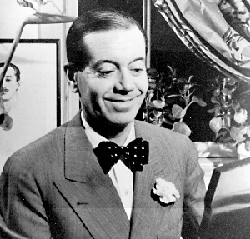
Paris Hilton's sexy new commercial for Carl's Jr. restaurants features the heiress washing a car to the music of Cole Porter's famous "I Love Paris."
Everyone knows the words to that song, written in 1952, for the musical Can-Can, which ran at Broadway's Schubert theater for 892 performances.
That song always reminds me of one night in Paris a few years back, stumbling back to my hotel in the Latin Quarter after a great drunk, smoking a Gitanes and mumbling the words in order to keep awake and upright.
"God... Oh God... do i love Paris... Because my room is near..."
But the same man who wrote I Love Paris, also wrote the following lyric, which i quote for you all as you try to decide where to spend your summer vacation this year.
See America FirstOf European lands effete,
A most inveterate foe,
My feelings when my camp I greet
Are such as patriots know.
Condemning trips across the blue
As dollars badly dispersed,
I hold that loyal men and true,
Including in the category all of you,
Should see America first,
Should see America first.All hail salubrious sky,
All hail salubrious sky.
Observe when I invoke the sky
It echoes reassuringly
That one should try to see America first,
To see America first.Of course it's really not the sky,
But just a repetition of his battle cry,
To see America first,
To see America first,So ev'ry true American,
Whether right or red or black or tan,
Should push this patriotic plan
To see America first.
See America First was the first Cole Porter musical produced on Broadway, back in 1916. He went on to write twenty-three Broadway shows over five decades, and something over 800 songs. According to Robert Kimball's The Complete Lyrics of Cole Porter, the above lyric for the title song was changed to a more "Cohan-esque" version for the actual show. Hard to imagine old George M. finding fault with the original, though.
Posted by: annika at
07:22 AM
| Comments (5)
| Add Comment
Post contains 364 words, total size 2 kb.
June 01, 2005
I Know the Way You Can Get
I know the way you can get
When you have not had a drink of Love:Your face hardens,
Your sweet muscles cramp.
Children become concerned
About a strange look that appears in your eyes
Which even begins to worry your own mirror
And nose.Squirrels and birds sense your sadness
And call an important conference in a tall tree.
They decide which secret code to chant
To help your mind and soul.Even angels fear that brand of madness
That arrays itself against the world
And throws sharp stones and spears into
The innocent
And into one's self.O I know the way you can get
If you have not been drinking Love:You might rip apart
Every sentence your friends and teachers say,
Looking for hidden clauses.You might weigh every word on a scale
Like a dead fish.You might pull out a ruler to measure
From every angle in your darkness
The beautiful dimensions of a heart you once
Trusted.I know the way you can get
If you have not had a drink from Love's
Hands.That is why all the Great Ones speak of
The vital need
To keep remembering God,
So you will come to know and see Him
As being so Playful
And Wanting,
Just Wanting to help.That is why Hafiz says:
Bring your cup near me.
For all I care about
Is quenching your thirst for freedom!All a Sane man can ever care about
Is giving Love!
Here is the story of how the young Hafiz, who worked in a bakery, decided to devote his life to God:
[O]ne day at the bakery, one of the workers who delivered the bread was sick, and Hafiz had to deliver the bread to a certain quarter of Shiraz where the prosperous citizens lived. While taking the bread to a particular mansion, Hafiz's eyes fell upon the form of a young woman who was standing on one of the mansion's balconies. Her name was Shakh-i-Nabat which means 'Branch of Sugarcane'. Her beauty immediately intoxicated Hafiz and he fell hopelessly in love with her. Her beauty had such a profound effect on him that he almost lost consciousness. At night he could not sleep and he no longer felt like eating. He learnt her name and he began to praise her in his poems.In his lifetime, Hafiz had a large following but he was not popular with the fundamentalist clergy of his day. He was exiled for a time, and at his death they tried unsuccessfully to stop Hafiz from being buried as a Muslim because his poetry was not pious enough.Hafiz heard that she had been promised in marriage to a prince of Shiraz and realized how hopeless was his quest for her love. Still, the vision of her beauty filled his heart, and his thoughts were constantly with her. Then one day he remembered the famous 'promise of Baba Kuhi'. Baba Kuhi was a Perfect Master-Poet. . . . The promise that Baba Kuhi had given before he died was that if anyone could stay awake for forty consecutive nights at his tomb he would be granted the gift of poetry, immortality, and his heart's desire. Hafiz, interested in the third of these three, vowed to keep this vigil that no one had yet been able to keep.
Every day Hafiz would go to work at the bakery, then he would eat, and then walk past the house of Shakh-i-Nabat, who had heard some of the poems that he had composed in praise of her. She had noticed him passing her window every afternoon, each day more weary, but with a fire in his eyes that had lit the lamp of her heart for him. By this time Hafiz was in a kind of a trance. Everything that he did was automatic, and the only thing that kept him going was the fire in his heart and his determination to keep the lonely vigil.
Early the next morning the Angel Gabriel (some say Khizer) appeared to him. Gabriel gave Hafiz a cup to drink which contained the Water of Immortality, and declared that Hafiz had also received the gift of poetry. Then Gabriel asked Hafiz to express his heart's desire. All the time that this was happening, Hafiz could not take his eyes of Gabriel. So great was the beauty of the Angel that Hafiz had forgotten the beauty of Shakh-i-Nabat. After Gabriel had asked the question, Hafiz thought; 'If Gabriel the Angel of God is so beautiful, then how much more beautiful God must be.' Hafiz answered Gabriel: 'I want God!'
Posted by: annika at
12:39 AM
| Comments (5)
| Add Comment
Post contains 887 words, total size 5 kb.
May 25, 2005
Today we had a long conversation about art and poetry and he mentioned that he loved Wordsworth. i said that the only poem i remembered by Wordsworth was one about London, which i discovered while i lived there for a short time. He said "oh yes, the sonnet 'Composed on Westminster Bridge'" i said, "um yah, that one." He then recited it from memory.
Way to make me feel uneducated, dude.
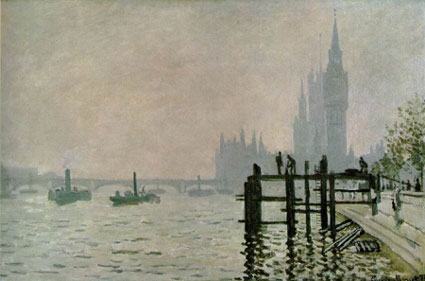
Composed Upon Westminster Bridge, September 3, 1802Earth has not anything to show more fair:
Dull would he be of soul who could pass by
A sight so touching in its majesty:
This City now doth like a garment wear
The beauty of the morning; silent, bare,
Ships, towers, domes, theatres, and temples lie
Open unto the fields, and to the sky;
All bright and glittering in the smokeless air.
Never did sun more beautifully steep
In his first splendour valley, rock, or hill;
Ne'er saw I, never felt, a calm so deep!
The river glideth at his own sweet will:
Dear God! the very houses seem asleep;
And all that mighty heart is lying still!
i love that poem because it's as atmospheric as the Monet i posted up above, which i saw in person at the National Gallery. "This City now doth like a garment wear/ The beauty of the morning; silent, bare." Reminds me of so many lovely mornings i spent walking to class through the ancient gray city. Just lovely.
Posted by: annika at
01:31 AM
| Comments (9)
| Add Comment
Post contains 309 words, total size 2 kb.
May 18, 2005
WarningWhen I am an old woman I shall wear purple
With a red hat which doesn´t go, and doesn´t suit me,
And I shall spend my pension on brandy and summer gloves
And satin sandals, and say we´ve no money for butter.
I shall sit down on the pavement when I´m tired
And gobble up samples in shops and press alarm bells
And run my stick along the public railings
And make up for the sobriety of my youth.
I shall go out in my slippers in the rain
And pick the flowers in other people´s gardens
And learn to spit.You can wear terrible shirts and grow more fat
And eat three pounds of sausages at a go
Or only bread and pickle for a week
And hoard pens and pencils and beermats and things in boxes.But now we must have clothes to keep us dry
And pay our rent and not swear in the street
And set a good example for the children.
We will have friends to dinner and read the papers.But maybe I ought to practise a little now?
So people who know me are not too shocked and surprised
When suddenly I am old and start to wear purple.
Sounds like a plan.
Posted by: annika at
10:21 AM
| Comments (4)
| Add Comment
Post contains 228 words, total size 1 kb.
May 11, 2005
A Ginsberg poem has been overdue for quite some time. Here's one that references Ken Kesey: beat author, champion wrestler, CIA guinea pig, author of One Flew Over The Cuckoo's Nest, and a man who arguably inspired today's rave scene with his Electric Kool Aid Acid Tests of the mid-sixties, which in turn launched the careers of Tom Wolfe and The Grateful Dead.
Here's how his friend, Allen Ginsberg, described one of Kesey's infamous get-togethers in 1965:
First Party at Ken Kesey's with Hell's AngelsCool black night thru redwoods
cars parked outside in shade
behind the gate, stars dim above
the ravine, a fire burning by the side
porch and a few tired souls hunched over
in black leather jackets. In the huge
wooden house, a yellow chandelier
at 3 A.M. the blast of loudspeakers
hi-fi Rolling Stones Ray Charles Beatles
Jumping Joe Jackson and twenty youths
dancing to the vibration thru the floor,
a little weed in the bathroom, girls in scarlet
tights, one muscular smooth skinned man
sweating dancing for hours, beer cans
bent littering the yard, a hanged man
sculpture dangling from a high creek branch,
children sleeping softly in their bedroom bunks.
And 4 police cars parked outside the painted
gate, red lights revolving in the leaves.
If you look, Kesey's name seems to pop up everywhere. The Who and The Beatles wrote songs about his antics. Hunter S. Thompson introduced him to the Hells Angels, who became regular fixtures at Kesey's parties in the hills west of Palo Alto. (That is, until September 1966, when several of them beat him up pretty badly.) Timothy Leary and Jack Kerouac met him, but were unimpressed. Neal Cassady and Robert Pirsig were close friends. Kesey was like the Kevin Bacon of the beat and hippie countercultures.
More poetry: Steve celebrates his new OS with a little Blake.
Posted by: annika at
08:16 PM
| Comments (5)
| Add Comment
Post contains 320 words, total size 2 kb.
May 04, 2005
Vegetable LoveI´d like to say the fridge
was clean, but look at the rusty
streaks down the back wall
and the dusty brown pools
underneath the salad crisper.And this is where I´ve lived
the past two weeks, since I was pulled
from the vegetable garden.
I´m wild for him: I want to stay crunchy
enough to madden his hard palate and his tongue,
every sensitive part inside his mouth.
But almost hour by hour now, it seems,
I can feel my outer leaves losing resistance,
as oxygen leaks in, water leaks out
and the same tendency creeps further
and further towards my heart.Down here there´s not much action,
just me and another, even limper, lettuce
and half an onion. The door opens so many,
so many times a day, but he never opens
the salad drawer where I´m curled in a corner.There´s an awful lot of meat. Strange cuts:
whole limbs with their grubby hair,
wings and thighs of large birds,
claws and beaks. New juice
gathers pungency as it rolls down
through the smelly strata of the refrigerator,
and drips on to our fading heads.The thermostat is kept as low as it will go,
and when the weather changes
for the worse, what´s nearest
to the bottom of the fridge starts to freeze.
Three times we´ve had cold snaps,
and I´ve felt the terrifying pain
as ice crystals formed at my fringes.Insulation isn´t everything in here:
you´ve got to relax into the cold,
let it in at every pore. It´s proper
for food preservation. But I heat up
again at the thought of him,
at the thought of mixing into one juice
with his saliva, of passing down his throat
and being ingested with the rest
into his body cells where I´ll learn
by osmosis another lovely version
of curl, then shrivel, then open again to desire.
More food poetry: Kevin posted something about the beguiling food-like substance, Nutella. With pictures here.
Posted by: annika at
07:38 AM
| Comments (3)
| Add Comment
Post contains 352 words, total size 2 kb.
April 27, 2005
New Republic literary editor Leon Wieseltier described Amichai's work this way: "Perhaps the most remarkable thing about Yehuda Amichai is his composure. From a life cluttered with ancient torments, with the collective memory of his people's pains and the personal recollection of his own, he calmly extracts the essences, and leaves the rest for laughter. These are elementary poems by an elementary man."
This one, i love:
A Man In His LifeA man doesn't have time in his life
to have time for everything.
He doesn't have seasons enough to have
a season for every purpose. Ecclesiastes
Was wrong about that.A man needs to love and to hate at the same moment,
to laugh and cry with the same eyes,
with the same hands to throw stones and to gather them,
to make love in war and war in love.
And to hate and forgive and remember and forget,
to arrange and confuse, to eat and to digest
what history
takes years and years to do.A man doesn't have time.
When he loses he seeks, when he finds
he forgets, when he forgets he loves, when he loves
he begins to forget.And his soul is seasoned, his soul
is very professional.
Only his body remains forever
an amateur. It tries and it misses,
gets muddled, doesn't learn a thing,
drunk and blind in its pleasures
and its pains.He will die as figs die in autumn,
Shriveled and full of himself and sweet,
the leaves growing dry on the ground,
the bare branches pointing to the place
where there's time for everything.
Posted by: annika at
12:11 AM
| Comments (8)
| Add Comment
Post contains 329 words, total size 2 kb.
April 20, 2005
It's a long one, but if you've never read it please enjoy it all the way to the end. Longfellow was great at telling a story, and this is a great story to tell. Listen to the galloping rhythm of the meter as you read. It's wonderful.
Paul Revere's RideListen my children and you shall hear
Of the midnight ride of Paul Revere,
On the eighteenth of April, in Seventy-five;
Hardly a man is now alive
Who remembers that famous day and year.He said to his friend, "If the British march
By land or sea from the town to-night,
Hang a lantern aloft in the belfry arch
Of the North Church tower as a signal light,--
One if by land, and two if by sea;
And I on the opposite shore will be,
Ready to ride and spread the alarm
Through every Middlesex village and farm,
For the country folk to be up and to arm."
Then he said "Good-night!" and with muffled oar
Silently rowed to the Charlestown shore,
Just as the moon rose over the bay,
Where swinging wide at her moorings lay
The Somerset, British man-of-war;
A phantom ship, with each mast and spar
Across the moon like a prison bar,
And a huge black hulk, that was magnified
By its own reflection in the tide.Meanwhile, his friend through alley and street
Wanders and watches, with eager ears,
Till in the silence around him he hears
The muster of men at the barrack door,
The sound of arms, and the tramp of feet,
And the measured tread of the grenadiers,
Marching down to their boats on the shore.Then he climbed the tower of the Old North Church,
By the wooden stairs, with stealthy tread,
To the belfry chamber overhead,
And startled the pigeons from their perch
On the sombre rafters, that round him made
Masses and moving shapes of shade,--
By the trembling ladder, steep and tall,
To the highest window in the wall,
Where he paused to listen and look down
A moment on the roofs of the town
And the moonlight flowing over all.Beneath, in the churchyard, lay the dead,
In their night encampment on the hill,
Wrapped in silence so deep and still
That he could hear, like a sentinel's tread,
The watchful night-wind, as it went
Creeping along from tent to tent,
And seeming to whisper, "All is well!"
A moment only he feels the spell
Of the place and the hour, and the secret dread
Of the lonely belfry and the dead;
For suddenly all his thoughts are bent
On a shadowy something far away,
Where the river widens to meet the bay,--
A line of black that bends and floats
On the rising tide like a bridge of boats.Meanwhile, impatient to mount and ride,
Booted and spurred, with a heavy stride
On the opposite shore walked Paul Revere.
Now he patted his horse's side,
Now he gazed at the landscape far and near,
Then, impetuous, stamped the earth,
And turned and tightened his saddle girth;
But mostly he watched with eager search
The belfry tower of the Old North Church,
As it rose above the graves on the hill,
Lonely and spectral and sombre and still.
And lo! as he looks, on the belfry's height
A glimmer, and then a gleam of light!
He springs to the saddle, the bridle he turns,
But lingers and gazes, till full on his sight
A second lamp in the belfry burns.
A hurry of hoofs in a village street,
A shape in the moonlight, a bulk in the dark,
And beneath, from the pebbles, in passing, a spark
Struck out by a steed flying fearless and fleet;
That was all! And yet, through the gloom and the light,
The fate of a nation was riding that night;
And the spark struck out by that steed, in his flight,
Kindled the land into flame with its heat.
He has left the village and mounted the steep,
And beneath him, tranquil and broad and deep,
Is the Mystic, meeting the ocean tides;
And under the alders that skirt its edge,
Now soft on the sand, now loud on the ledge,
Is heard the tramp of his steed as he rides.It was twelve by the village clock
When he crossed the bridge into Medford town.
He heard the crowing of the cock,
And the barking of the farmer's dog,
And felt the damp of the river fog,
That rises after the sun goes down.
It was one by the village clock,
When he galloped into Lexington.
He saw the gilded weathercock
Swim in the moonlight as he passed,
And the meeting-house windows, black and bare,
Gaze at him with a spectral glare,
As if they already stood aghast
At the bloody work they would look upon.It was two by the village clock,
When he came to the bridge in Concord town.
He heard the bleating of the flock,
And the twitter of birds among the trees,
And felt the breath of the morning breeze
Blowing over the meadow brown.
And one was safe and asleep in his bed
Who at the bridge would be first to fall,
Who that day would be lying dead,
Pierced by a British musket ball.
You know the rest. In the books you have read
How the British Regulars fired and fled,---
How the farmers gave them ball for ball,
From behind each fence and farmyard wall,
Chasing the redcoats down the lane,
Then crossing the fields to emerge again
Under the trees at the turn of the road,
And only pausing to fire and load.So through the night rode Paul Revere;
And so through the night went his cry of alarm
To every Middlesex village and farm,---
A cry of defiance, and not of fear,
A voice in the darkness, a knock at the door,
And a word that shall echo for evermore!
For, borne on the night-wind of the Past,
Through all our history, to the last,
In the hour of darkness and peril and need,
The people will waken and listen to hear
The hurrying hoof-beats of that steed,
And the midnight message of Paul Revere.
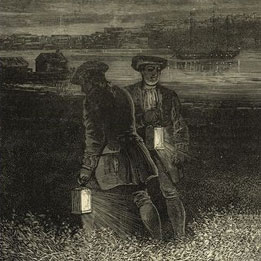
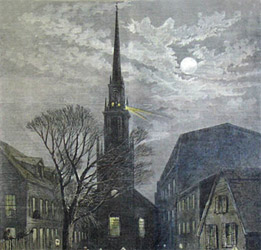
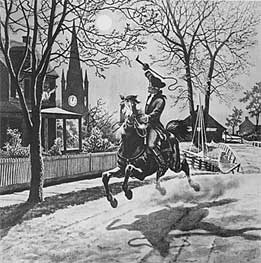
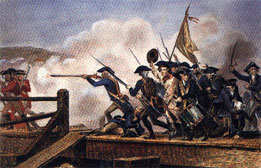
Stirring. Doesn't that give you goose-bumps?
The other poems i've memorized include Jabberwocky, The Star Spangled Banner and Desdemona's lines from a scene i did for a college acting class. The only one still left in my head is Jabberwocky.
If you're interested, here's a history of the various frigates named H.M.S. Somerset.
Posted by: annika at
12:01 AM
| Comments (6)
| Add Comment
Post contains 1144 words, total size 7 kb.
April 13, 2005
Here's a poem by W. D. Snodgrass, perfect for April, which also deals with the midlife crisis theme.
April InventoryThe green catalpa tree has turned
All white; the cherry blooms once more.
In one whole year I haven't learned
A blessed thing they pay you for.
The blossoms snow down in my hair;
The trees and I will soon be bare.The trees have more than I to spare.
The sleek, expensive girls I teach,
Younger and pinker every year,
Bloom gradually out of reach.
The pear tree lets its petals drop
Like dandruff on a tabletop.The girls have grown so young by now
I have to nudge myself to stare.
This year they smile and mind me how
My teeth are falling with my hair.
In thirty years I may not get
Younger, shrewder, or out of debt.The tenth time, just a year ago,
I made myself a little list
Of all the things I'd ought to know,
Then told my parents, analyst,
And everyone who's trusted me
I'd be substantial, presently.I haven't read one book about
A book or memorized one plot.
Or found a mind I did not doubt.
I learned one date. And then forgot.
And one by one the solid scholars
Get the degrees, the jobs, the dollars.And smile above their starchy collars.
I taught my classes Whitehead's notions;
One lovely girl, a song of Mahler's.
Lacking a source-book or promotions,
I showed one child the colors of
A luna moth and how to love.I taught myself to name my name,
To bark back, loosen love and crying;
To ease my woman so she came,
To ease an old man who was dying.
I have not learned how often I
Can win, can love, but choose to die.I have not learned there is a lie
Love shall be blonder, slimmer, younger;
That my equivocating eye
Loves only by my body's hunger;
That I have forces true to feel,
Or that the lovely world is real.While scholars speak authority
And wear their ulcers on their sleeves,
My eyes in spectacles shall see
These trees procure and spend their leaves.
There is a value underneath
The gold and silver in my teeth.Though trees turn bare and girls turn wives,
We shall afford our costly seasons;
There is a gentleness survives
That will outspeak and has its reasons.
There is a loveliness exists,
Preserves us, not for specialists.
Posted by: annika at
02:38 AM
| Comments (4)
| Add Comment
Post contains 458 words, total size 3 kb.

The poet Charles Bernstein doesn't think National Poetry Month is good for poetry. He writes: "promoting poetry as if it were an 'easy listening' station just reinforces the idea that poetry is culturally irrelevant and has done a disservice not only to poetry deemed too controversial or difficult to promote but also to the poetry it puts forward in this way." i see where he's coming from. That's why at annika's journal i do my own dissservice to poetry all year long. Anyways, i liked this idea from Bernstein's essay:
As an alternative to National Poetry Month, I propose that we have an International Anti-Poetry month. As part of the activities, all verse in public places will be covered over—from the Statue of Liberty to the friezes on many of our government buildings. Poetry will be removed from radio and TV (just as it is during the other eleven months of the year). Parents will be asked not to read Mother Goose and other rimes to their children but only ... fiction. Religious institutions will have to forego reading verse passages from the liturgy and only prose translations of the Bible will recited, with hymns strictly banned. Ministers in the Black churches will be kindly requested to stop preaching. Cats will be closed for the month by order of the Anti-Poetry Commission. Poetry readings will be replaced by self-help lectures. Love letters will have to be written only in expository paragraphs. Baseball will have to start its spring training in May. No vocal music will be played on the radio or sung in the concert halls. Children will have to stop playing all slapping and counting and singing games and stick to board games and football.Read the whole essay here.
Posted by: annika at
02:26 AM
| Comments (1)
| Add Comment
Post contains 306 words, total size 2 kb.
April 06, 2005
He wasn't alone.
His muscles grew into the flesh of the crowd, energy their pulse,
As long as they held a hammer, as long as his feet felt the ground.
And a stone smashed his temples and cut through his heart's chamber.
They took his body and walked in a silent line
Toil still lingered about him, a sense of wrong.
They wore gray blouses, boots ankle-deep in mud.
In this, they showed the end.
How violently his time halted: the pointers on the low voltage dials jerked, then dropped to zero again.
White stone now within him, eating into his being, taking over enough of him to turn him into stone.
Who will lift up that stone, unfurl his thoughts again under the cracked temples?
So plaster cracks on the wall.
They laid him down, his back on a sheet of gravel.
His wife came, worn out with worry; his son returned from school
Should his anger now flow into the anger of others?
It was maturing in him through his own truth and love
Should he be used by those who came after, deprived of substance, unique and deeply his own?
The stones on the move again; a wagon bruising the flowers.
Again the electric current cuts deep into the walls.
But the man has taken with him the world's inner structure,where the greater the anger, the higher the explosion of love.
Ironically, while the quarry killed the subject of that poem, it actually saved Karol's life. Many people from his town had been rounded up by the Nazis and sent to Auschwitz and other death camps, including theatre friends and University teachers. (The town of Wadowice was about 20% Jewish before the war.) Karol was himself arrested in 1942, but released because quarry work was considered a "vital industry."
More poetry by the late Pope can be found at the Frontline site, along with a discussion of his work by poet Lynn Powell.
[cross-posted at A Western Heart]
Posted by: annika at
07:39 AM
| Comments (7)
| Add Comment
Post contains 394 words, total size 2 kb.
 Just dropping by to say hi, as you do.
>_>
Just dropping by to say hi, as you do.
>_>March 30, 2005
To One Shortly to DieFrom all the rest I single out you, having a message for you:
You are to die—Let others tell you what they please, I cannot prevaricate,
I am exact and merciless, but I love you—There is no escape for you.
Softly I lay my right hand upon you—you just feel it,
I do not argue—I bend my head close, and half envelope it,
I sit quietly by—I remain faithful,
I am more than nurse, more than parent or neighbor,
I absolve you from all except yourself, spiritual, bodily—that is eternal—you yourself will surely escape,
The corpse you will leave will be but excrementitious.
The sun bursts through in unlooked-for directions!
Strong thoughts fill you, and confidence—you smile!
You forget you are sick, as I forget you are sick,
You do not see the medicines—you do not mind the weeping friends—I am with you,
I exclude others from you—there is nothing to be commiserated,
I do not commiserate—I congratulate you.
Posted by: annika at
10:09 AM
| Comments (8)
| Add Comment
Post contains 186 words, total size 1 kb.
March 23, 2005
Since everybody's grumbling these days about gas prices, i thought i'd select a nostalgic poem that takes us back to the days when gas was cheap, Exxon was Esso, and full service was the rule.
Filling StationOh, but it is dirty!
--this little filling station,
oil-soaked, oil-permeated
to a disturbing, over-all
black translucency.
Be careful with that match!Father wears a dirty,
oil-soaked monkey suit
that cuts him under the arms,
and several quick and saucy
and greasy sons assist him
(it's a family filling station),
all quite thoroughly dirty.Do they live in the station?
It has a cement porch
behind the pumps, and on it
a set of crushed and grease-
impregnated wickerwork;
on the wicker sofa
a dirty dog, quite comfy.Some comic books provide
the only note of color--
of certain color. They lie
upon a big dim doily
draping a taboret
(part of the set), beside
a big hirsute begonia.Why the extraneous plant?
Why the taboret?
Why, oh why, the doily?
(Embroidered in daisy stitch
with marguerites, I think,
and heavy with gray crochet.)Somebody embroidered the doily.
Somebody waters the plant,
or oils it, maybe. Somebody
arranges the rows of cans
so that they softly say:
ESSO--SO--SO--SOto high-strung automobiles.
Somebody loves us all.
This being poetry Wednesday, let me also refer you to Ginger, who has something nice, and also to Jeff, who has something silly.
Posted by: annika at
11:24 AM
| No Comments
| Add Comment
Post contains 277 words, total size 2 kb.
March 16, 2005
Farrokhzad was a rebel who challenged cultural and political absolutism in her all-too-brief, 15-year literary career. She was a daring explorer of a public language of intimacy and transgression. The epitome of what the Islamic Republic wanted to eradicate, Farrokhzad is now the Iranian equivalent of a rock star. . . .It's easy for me to imagine why Farrokhzad would appeal to the women of today's Iran. She challenged sexual mores by leaving her husband when she was twenty-one to be with her lover. What would the mullahs have done with such a poet, i wonder. Her writing is celebratory, unapolagetic, and very sexual.Her popularity is one of the many dizzying paradoxes any casual visitor encounters in Iran 25 years after the Islamic revolution. Iranian women can drive cars but cannot ride bicycles. They are on the world stage as Nobel Peace laureates, human rights activists, best-selling authors, prize-winning film directors and Oscar nominees -- yet they cannot leave the country without the written permission of their husbands. They are some of the most fashionable women in the world but must observe an obligatory dress code in Iran.
I SinnedBeside a body, tremulous and dazed
I sinned, I voluptuously sinned.
O God! How could I know what I did
in that dark retreat of silence?In that dark retreat of silence
I looked into his mysterious eyes
my heart trembled restlessly
at the pleading in his eyes.In that dark retreat of silence
I sat, disheveled, beside him
passion poured from his lips into mine
saved I was from the a agony of a foolish heart.I whispered the tale of love in his ears:
I want you, 0 sweetheart of mine
I want you, 0 life-giving bosom
I want you, 0 mad lover of mine.Passion struck a flame in his eyes
the red wine danced in the glass
in the soft bed, my body
shivered drunk on his breast.I sinned, I voluptuously sinned
in arms hot and fiery
I sinned in his arms
iron-strong, hot, and avenging.
i am amazed at the new popularity of Farrokhzad's poetry. It's a good sign. In Reading Lolita In Tehran, Azar Nafisi writes about the oppressive ideological censorship under the mullahs after the Revolution:
Our world under the mullahs' rule was shaped by the colorless lenses of the blind censor. [Afisi notes that the chief censor, up until 1994, actually was blind.] Not just our reality but also our fiction had taken on this curious coloration in a world where the censor was the poet's rival in rearranging and reshaping reality, where we simultaneously invented ourselves and were figments of someone else's imagination.Forugh Farrokhzad is a heroine for this new generation of Iranian women, who long to be free.. . .
In the course of nearly two decades, the streets have been turned into a war zone, where young women who disobey the rules are hurled into patrol cars, taken to jail, flogged, fined, forced to wash the toilets and humiliated, and as soon as they leave, they go back and do the same thing. . . . [H]ow vulnerable the Revolutionary Guards are who for over eighteen years have patrolled the streets of Tehran and have had to endure young women . . . walking, talking, showing a strand of hair just to remind them that they have not converted.
Born AgainThe clock flew away
The curtain went away with the wind
I had squeezed him
In the halo of fire
I wanted to speak
But, ohh!
His dense shady eyelashes
Like the fringes of a silk curtain
Flowed from the depth of darkness
Along the quiver, that deadly quivers,
Down the lost end of mineI felt I was being freed,
I felt I was being freed,I felt my skin burst in the expansion of love
I felt my fiery mass melt slowly,
And then it trickled
Trickled,
Trickled
Down into the moon, the sunken, agitated dark moon
Wow. A poem about orgasm and its afterglow, yes, but it's really about revolution, isn't it?
[Technorati Tag: poetry]
Posted by: annika at
06:59 AM
| Comments (4)
| Add Comment
Post contains 733 words, total size 5 kb.
March 11, 2005
Garrison Keillor also reminds us that today is Douglas Adams' birthday.
Posted by: annika at
09:39 AM
| Comments (3)
| Add Comment
Post contains 32 words, total size 1 kb.
March 10, 2005
Either of them?
Sure i was a little tongue-in-cheek at times, but nothing that Gene Simmons himself wouldn't have appreciated.
So i got this comment today from some dude with sense of humor issues.
Name: IggyOuch. That wit is razor sharp.
Email Address: iggy@kissrocks.comComments:
Kiss Rules-Fuck you and your site!! BIATCH!!!
And you wonder why i drink so much.
Posted by: annika at
06:57 PM
| Comments (6)
| Add Comment
Post contains 89 words, total size 1 kb.
March 09, 2005
Okay, to the web. Raymond Carver is described thusly at Writer's Calendar:
American short-story writer and poet, a major force in the revitalization of the short story in the 1980s. Carver's reputation continued to grow after his death at the age of fifty.Carver, who died in 1988, studied at Cal State Chico and Cal State Humboldt, where he got his BA. (Both are infamous party schools today.) Chico honors him with a festival every year. Carver also taught English at Syracuse, and Jay McInerney (author of the eighties classic, Bright Lights, Big City) is a former student.. . .
Raymond Carver was born in Clatskanie, a mill town on the Columbia River in Oregon. His father, a sawmill worker, was an alcoholic. At home he used to tell him stories about his own hunting and fishing exploits, and about his grandfather, who had fought in the Civil War, for both sides.
Carver published his . . . first poem, 'The Brass Ring,' in Targets, which also had a poem by Charles Bukowski. During these years of working in different jobs, rising kids, and trying to write, Carver started to drink. 'Alcohol became a problem. I more or less gave up, threw in the towel, and took to full-time drinking as a serious pursuit.'Today's poem is a drunk poem, but a good one.
CheersVodka chased with coffee. Each morning
I hang the sign on the door:OUT TO LUNCH
But no one pays attention; my friends
look at the sign and
sometimes leave little notes,
or else they call - Come out and play,
Ray - mond.Once my son, that bastard,
slipped in and left me a colored egg
and a walking stick.
I think he drank some of my vodka.
And last week my wife dropped by
with a can of beef soup
and a carton of tears.
She drank some of my vodka, too, I think,
then left hurriedly in a strange car
with a man I'd never seen before.
They don't understand; I'm fine,
just fine where I am, for any day now
I shall be, I shall be, I shall be . . .I intend to take all the time in this world,
consider everything, even miracles,
yet remain on guard, ever
more careful, more watchful,
against those who would sin against me,
against those who would steal vodka,
against those who would do me harm.
The end of Carver's bio is both redemptive and tragic.
On June 2, 1977 Carver stopped drinking with the help of Alcoholics Anonymous. After this 'line of demarcation' his stories became increasingly more expansive. In 1982 Carver divorced Maryann. From 1979 Carver had lived with the poet Tess Gallagher (b.1943), they had met at a writers' conference in Dallas. They married in 1988. The wedding took place in Reno. Two months later, on August 2, 1988, the author died of lung cancer. . . . After writing [the] story, 'Errand,' about Chekhov's death, Carver learned that he had cancer.The Writer's Calendar bio compares Carver's poetry and prose to Chekov, Bukowski, William Carlos Williams, Kafka, Pinter, and Richard Ford. (i'm a fan of all of those writers, with the possible exception of Ford. So, thanks for the suggestion, Paul, i'll have to check out more of Carver's stuff.)
Posted by: annika at
04:40 PM
| Comments (1)
| Add Comment
Post contains 603 words, total size 4 kb.
March 02, 2005
Book I Part XIVDonÂ’t delight in curling your hair with tongs,
donÂ’t smooth your legs with sharp pumice stone.
Leave that to those who celebrate Cybele the Mother,
howling wildly in the Phrygian manner.
Male beautyÂ’s better for neglect: Theseus
carried off Ariadne, without a single pin in his hair.
Phaedra loved Hippolytus: he was unsophisticated:
Adonis was dear to the goddess, and fit for the woods.
Neatness pleases, a body tanned from exercise:
a well fitting and spotless togaÂ’s good:
no stiff shoe-thongs, your buckles free of rust,
no sloppy feet for you, swimming in loose hide:
donÂ’t mar your neat hair with an evil haircut:
let an expert hand trim your head and beard.
And no long nails, and make sure theyÂ’re dirt-free:
and no hairs please, sprouting from your nostrils.
No bad breath exhaled from unwholesome mouth:
donÂ’t offend the nose like a herdsman or his flock.
Leave the rest for impudent women to do,
or whoeverÂ’s the sort of man who needs a man.
Translation by A. S. Kline, 2001.
In other words, don't stink, brush your teeth once in a while, keep yourself clean, but not too neat. Some muscles and a nice tan are always a plus. Chicks still dig a manly man, so please don't shave your legs and it's time to stop getting free haircuts from mom. Spend the money on a good stylist, but don't overdo it. You don't wanna look like a chick, and you definitely don't wanna look gay.
A lumberjack style plaid toga might have been a good choice when cruising the forum for babes, i would imagine.
Posted by: annika at
10:40 PM
| Comments (8)
| Add Comment
Post contains 342 words, total size 2 kb.
February 25, 2005
Oooooh-kaaaaay.
*dials 911*
Posted by: annika at
09:55 AM
| Comments (4)
| Add Comment
Post contains 15 words, total size 1 kb.
February 23, 2005
A simple google search yielded this gem:
Poem 3by TB788-E10-D
Oh baby you're so divine
with all those terabytes of fast cache
behind your flip-o-flex patented green irises.
I love the look of your sleek silver fins
and your interchangeable gold-rimmed
elbow and knee joints.Oh, you are such a fashion statement baby.
The sight of your one point eight kilo capacity
frontal lobes makes me want to
re-scan the Kama Sutra every seven seconds
and stochastically generate a thousand and one
new positions for us to try.Let's inter-collate indices daily
and murmur at sunset another tale from
Arabian Nights.
Oh, you exotic chrome and vanadium sweetie.
Oh, how I dig you to bits.
Pretty funny, but shouldn't it properly be called Poem 11?*
Also check out "Robot Barcode Poetry" at a blog called Sean. And there are some interesting Robot Builder limericks at the nerdy Dallas Personal Robotics Group website.
_______________
* As in: Only 11 more days until the end of Robot Week!
Posted by: annika at
09:44 AM
| Comments (5)
| Add Comment
Post contains 185 words, total size 1 kb.
78 queries taking 0.1764 seconds, 279 records returned.
Powered by Minx 1.1.6c-pink.

