



June 20, 2006
I was perplexed by this cryptic passage.
While Iraq is trying to gain its independence from the United States and the coalition, in terms of taking greater responsibility for its actions, particularly in terms of security, there are still some influential foreign figures trying to spoon-feed our government and take a very proactive role in many key decisions. Though this may provide some benefits in the short term, in the long run it will only serve to make the Iraqi government a weaker one and eventually lead to a culture of dependency.Do any of you have ideas on who Mr. al-Rubaie meant when he referred to "some influential foreign figures?"
h/t Michelle Malkin.
Posted by: annika at
09:29 AM
| Comments (12)
| Add Comment
Post contains 160 words, total size 1 kb.

Today we mourn the loss of Pfc. Kristian Menchaca, 23, of Houston, Texas and Pfc. Thomas L. Tucker, 25, of Madras, Oregon.
Spc. David J. Babineau, 25, of Springfield, Massachussetts was also killed during the initial battle near Yousifiya last Friday.
All were assigned to the 1st Battalion, 502nd Infantry Regiment, 2nd Brigade, 101st Airborne Division from Fort Campbell, Ky.
Posted by: annika at
06:48 AM
| Comments (1)
| Add Comment
Post contains 64 words, total size 1 kb.
June 19, 2006
What an idiot. Froggy at Blackfive does a beautiful job explaining why.
Apparently Murtha also believes that Somalia and Beirut are good models for the proper use of American military power. Or non-use, I should say. Murtha said, "in Beirut President Reagan changed direction, in Somalia President Clinton changed direction, and yet here, with the troops out there every day, suffering from these explosive devices, and being looked at as occupiers [blah blah blah]"
Let's follow that logic a bit. Murtha would have advised Washington to withdraw after Valley Forge; Madison to give up after the burning of the White House; Lincoln to throw in the towel after Bull Run, both of them; FDR to redeploy all troops to San Diego after Bataan; etc. etc. you get the picture.
How long must we wait until Murtha takes MacArthur's advice and just faaades away. Not soon enough, I say.
Posted by: annika at
06:54 AM
| Comments (7)
| Add Comment
Post contains 174 words, total size 1 kb.
June 15, 2006
Check the AP reportage for example:
The Supreme Court ruled Thursday that police armed with a warrant can barge into homes and seize evidence even if they don't knock, a huge government victory that was decided by President Bush's new justices.The errors in that article are too numerous to list. For one thing, the cops in the Hudson case didn't "barge in," they announced themselves first then waited before trying the door, which was unlocked. But more importantly, the Supreme Court never said that police "can barge into homes and seize evidence even if they don't knock."The 5-4 ruling signals the court's conservative shift following the departure of moderate Sandra Day O'Connor.
Dissenting justices predicted that police will now feel free to ignore previous court rulings that officers with search warrants must knock and announce themselves or run afoul of the Constitution's Fourth Amendment ban on unreasonable searches.
Justice Antonin Scalia, writing for the majority, said Detroit police acknowledge violating that rule when they called out their presence at a man's door, failed to knock, then went inside* three seconds to five seconds later. The court has endorsed longer waits, of 15 seconds to 20 seconds.**
On the contrary, the Court upheld the knock rule. The Fourth Amendment still requires police executing a search warrant to knock first, announce their presence and provide the occupants a reasonable opportunity to open the door voluntarily. Today's ruling did not change that rule.
What the Court did do is apply the brakes to an out of control "exclusionary rule." Hudson v. Michigan is a quite sensible decision, and not even particularly conservative, in my opinion. I wonder if the AP reporter even read it.
Proponents of an expansive exclusionary rule want it to apply to any evidence obtained in the prosecution of a suspect, whenever the police fail to follow a procedural rule. In other words, some people believe that a judge should throw out all evidence against a defendant whenever the police fuck up, no matter what kind of fuck up it was. As Scalia noted, that would mean a "get-out-of-jail-free card" in many cases. This is what is known in the popular culture as "getting off on a technicality."
So, wouldn't it have been more accurate for the AP to describe today's decision as the Court limiting the ability of criminals to "go free" on "technicalities?"
The Hudson case does not overturn the exclusionary rule. It simply says that if police screw up on their constitutional requirement to knock before serving a search warrant, and the search later turns up a bunch of evidence that proves the dude was guilty as sin, the judge does not have to throw out all the evidence and let the guy go. I think that's totally reasonable. The exclusionary rule still applies when the cops commit more serious constitutional violations, like searching a house without a warrant.
Critics of the Hudson decision will say that without the exclusionary rule police might simply ignore the knock and enter requirement. Maybe so, maybe not. The Court pointed to other means available to punish cops for failing to knock, civil lawsuits and disciplinary measures for instance. Also, the Court pointed out that the knock requirement isn't even a hard and fast rule. Police can legally enter without knocking if they have reason to believe that evidence might be destroyed were they to knock first.
But the main point is that the cure would be much worse than the disease. If we were to let criminals go free just because the police failed to knock even though they had a valid search warrant, there would undoubtedly be crooks walking around who should be behind bars. The Hudson decision prevents this potential miscarriage of justice and restores balance to a small part of Fourth Amendment jurisprudence. Or to put it in Johnny Cochran-ese:
Just 'cuz the cop didn't knock,I'm glad the new Court is refusing to expand the exclusionary rule beyond its already unreasonable scope. I just wish that the media would explain the reasoning behind today's decision instead of trying to scare people unnecessarily.
don't mean we let the perp walk.
I give the New York Times opinion writer more slack for his wrongheaded piece, because at least that's an editorial. I would be disappointed if I didn't find wrongheadedness in a NYT editorial.
To be fair, some reporters seem to understand the Hudson case better. Two examples of more balanced articles can be found at CNN's site and at The Christian Science Monitor. Although I do have a semantic nit to pick about the Monitor's assertion that the decision is a setback to "privacy rights." While the right to privacy is related to Fourth Amendment freedoms, the two are not identical. As everyone should know by now, the right to privacy is not enumerated in the Constitution, whereas protection from unreasonable searches and seizures is.
_______________
* Again, the AP reporter "forgot" to mention that the criminal's door was unlocked.
** Here the AP reporter "forgot" to mention that the standard for deciding how long to wait is based on how long it would take a suspect to flush the evidence. Therefore, a reasonable wait time might be only a couple of seconds, depending on the particular evidence in the case.
Posted by: annika at
07:10 PM
| Comments (30)
| Add Comment
Post contains 916 words, total size 6 kb.
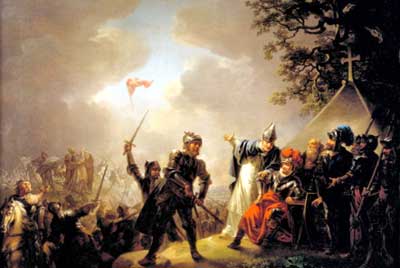
I got an email this morning from visitor Drake, who loves my blog by the way. (I actually encourage anyone and everyone to e-mail me for the purpose of telling me how much you love my blog.) Anyways, Drake alerted me to the following bit of information, Danish exports are UP!
As reported by The American Thinker:
The MSM in Denmark yesterday cited a brand-new report from the Danish ‘Institut for Konjunktur-Analyse’ that unambiguously shows that the “cartoon crisis” has had a positive impact on Danish exports. The export business is literally booming and the result for the first half of 2006 is expected to be the best in the last 4 years.So help celebrate Valdemarsdag, eat a danish today!Here’s an article from Denmarks largest financial newspaper. Unfortunately it’s in Danish (you might be able to extract the essentials from the headline nevertheless.) The article basically says that while the export to Islamic countries has gone down, this is more than compensated for by an increase in export to other countries, especially the USA! Senior analyst Joern Thulstrup is quoted as saying: (translated) “It’s an overlooked fact in the Danish debate that Denmark is held in very high regard in the USA, and this is really paying off in regard to business.”
Posted by: annika at
06:40 AM
| Comments (3)
| Add Comment
Post contains 267 words, total size 2 kb.
June 10, 2006
Update: AQ feelin the heat just a little? Via Preston, whom all the girls dig.
Posted by: annika at
09:31 AM
| Comments (6)
| Add Comment
Post contains 56 words, total size 1 kb.
June 09, 2006
Ignore the predictably negative headline and check out some key quotes from this article:
Abu Musab al-Zarqawi's death doesn't mean an end to the insurgency in Iraq — but it could mean a change in strategy.An even more optimistic AP story looks at the beating Al Qaeda leadership has taken around the world in the last two years. A partial rundown:"What Iraqi Sunnis want in Iraq is different from what al-Zarqawi wants," said Sadeq al-Musawi, who until February was President Jalal Talabani's political adviser. "Sunnis want to push out foreign forces from Iraq. Al-Zarqawi ... wanted Islamic rule and wanted to instigate civil war between Sunnis and Shiites."
The death on Wednesday of the al-Qaida in Iraq leader could also provide an opening for the Iraqi government to try to woo Sunni insurgents.
Deputy Prime Minister Salam Zikam Ali al-Zubaie, a Sunni, said the national unity government of Shiite Prime Minister Nouri al-Maliki was open to contacts with armed groups except those involved in the killing of civilians or opposed to the U.S.-backed political process.
There have been contacts in the past between envoys of the U.S. and Iraqi governments and various insurgent groups, but none is known to have produced any deals or progressed beyond the preliminary stages.
"Al-Qaida in Iraq and its supporters must be shaken by al-Zarqawi's death," al-Zubaie said Friday. "It has given security forces a boost," al-Zubaie said.
A 2004 Associated Press analysis named a dozen young terror suspects as front-line leaders, their hands stained with the blood of attacks from Bali to Baghdad, Casablanca to Madrid.Let's not forget the parliamentary approval of Iraq's new Defense and Interior ministers, and the newfound momentum of American troops against the insurgency. Add to those bits of good news, the announcement by Iraq's Prime Minister Nouri al-Maliki two weeks ago that "Our forces are capable of taking over the security in all Iraqi provinces within a year and a half," and things look even better.Al-Zarqawi, who sat atop the 2004 list as the biggest threat after bin Laden and his deputy Ayman al-Zawahri, died Wednesday when U.S. forces dropped two 500-pound bombs on his hideout northeast of Baghdad.
. . .
Globally, security forces have also had considerable success. Another four of the top 12 young militants in the 2004 list have met violent ends — in shootouts in Saudi Arabia, under U.S. bombardment in Iraq, or in an Algerian terror sweep. The seven who remain at large are on the run, and none has been able to match al-Zarqawi's success at launching large-scale attacks since mid-2004.
. . .
Joining al-Zarqawi in the list of dead militant leaders is Nabil Sahraoui, who took over the North African Salafist Group for Call and Combat in 2004 and announced that he was merging it with al-Qaida. Sahraoui did not have much time to savor his power play. The militant, who was in his 30s, was gunned down by Algerian troops that same year east of Algiers.
Habib Akdas, the accused ringleader of the 2003 bombings in Istanbul, Turkey, and another member of the class of 2004, died during the U.S. bombardment of the Iraqi city of Fallujah in November of that year, according to the testimony of an al-Qaida suspect in U.S. custody. Turkish security forces believe the account and say Akdas, who was also in his 30s, is dead.
Syrian-born Loa'i Mohammad Haj Bakr al-Saqa, who has emerged as an even more senior leader of the Istanbul bombings, but who was not included in the 2004 list of top terror suspects, is in a Turkish jail awaiting trial on terror charges.
Two other men who were on the 2004 list met their ends at the hands of security forces in Saudi Arabia.
Abdulaziz al-Moqrin, 30, who rose from high school dropout to become al-Qaida's leader in the kingdom, was cornered and killed by security forces in Riyadh in 2004, shortly after he masterminded the kidnapping and beheading of American engineer Paul M. Johnson.
In 2005, Saudi forces shot and killed Abdelkrim Mejjati, a Moroccan in his late 30s who was believed to have played a leading role in the May 2003 bombings in Casablanca that killed more than 30 people. Mejjati came from a privileged background, attending an exclusive French school in Morocco before turning to terrorism. He was sent to Saudi Arabia on bin Laden's orders, becoming one of the kingdom's most wanted men.
For most of those at large, life is anything but easy.
I've always been an optimist on Iraq and the War on Terror. I remained so even during the darkest days when the temptation to jump sides became too much to resist for better conservatives than I.
Still, I've never been one who, on this blog, was quick to announce certain "victories" as "turning points" or signs of "light at the end of the tunnel." I know that in war, as in life, the road to victory is often tortuous (definition 1). For every bit of good news, there's some bad news that the opposition will trumpet, so it's hard being an optimist when no one knows the ultimate outcome with certainty. But I'm a lot more hopeful today than I was a week ago. Maybe, just maybe, we've crested a hill over there.
Posted by: annika at
06:28 PM
| Comments (12)
| Add Comment
Post contains 907 words, total size 6 kb.
June 08, 2006
Statement by John Kerry on the Death of Abu Musab al-ZarqawiTime to declare victory and come home, eh? There was Caesar, Alexander, von Clausewitz, Sun Tzu, Eisenhower, and now John F. Kerry: military genius.Abu Musab al-Zarqawi was a brutal terrorist and his death strikes a blow to al-Qaeda in Iraq. This ruthless thug who abused the true meaning of Islam was an intruder on Iraqi soil and itÂ’s good news that heÂ’s dead. Our troops did an incredible job hunting him down and destroying him, and all of America is proud of their skill and commitment.
“With the end of al-Zarqawi and the confirmation of the final vital cabinet ministries in Iraq’s new government, it’s another sign that it’s time for Iraqis to stand up for Iraq, bring the factions together, end the insurgency, and run their own country. Our troops have done their job in Iraq, and they’ve done it valiantly. It’s time to work with the new Iraqi government to bring our combat troops home by the end of this year.” [emphasis added]
Posted by: annika at
06:38 PM
| Comments (5)
| Add Comment
Post contains 200 words, total size 1 kb.
 . Nice blog Annika.
Now that Al Zarqawi is getting fucked in the ass by his cellmates Pol Pot and Beria, I think we should celebrate the heroes who dropped the two 500 lb. JDAMs that killed him. Their victory is as historic at the one that occurred on April 17, 1943, also heralded as great news:
[A]s the mountains of Bougainville came into view [it was] 0934 when sharp-eyed Doug Canning called out "Bogeys, eleven o'clock. High." Mitchell couldn't believe it; there they were, right on schedule, exactly as planned. The Japanese planes appeared bright and new-looking to the pilots of the 339th. They jettisoned their drop tanks and bored in for the attack. Holmes and Hine had trouble with their tanks, only Barber and Lanphier of the killer group went after the Japanese bombers. All the other P-38s followed their instructions to fly cover.Link to the full history here.. . . The Lightnings had waded into the Japanese flight, pouring forth their deadly streams of lead. In the manner of all aerial combat, the fight was brief, high-speed, and confused. . . .
. . . Both Lanphier and Barber claimed one bomber shot down over the jungles of Bougainville. Frank Holmes claimed another shot down over the water a few minutes later. From Japanese records and survivors, among them Admiral Ugaki, the following facts are certain. Only two Betty bombers were involved; Yamamoto's was shot down over Bougainville with no survivors; the second went into the ocean and Ugaki lived to tell about it. Shortly after the attack, a Japanese search party located the wreckage, including the Admiral's body, which they ceremonially cremated.
. . .
The pilots uneventfully flew back to Guadalcanal, where upon landing, the ground personnel greeted them gleefully, like a winning football team. While Lanphier and Barber briefly disagreed about the air battle, all was subsumed in the generally celebratory atmosphere. Lanphier later recalled enjoying his best meal of the war that night.
Posted by: annika at
07:37 AM
| Comments (15)
| Add Comment
Post contains 332 words, total size 2 kb.
 . Theoretically I've been responsible for the deaths of thousands
June 06, 2006
VIENNA, Austria - A package of incentives presented Tuesday to Iran includes a provision for the United States to supply Tehran with some nuclear technology if it stops enriching uranium — a major concession by Washington, diplomats said.So far, it appears AP is out there alone on this development. The New York Times reported earlier that the package contained a combination of carrots and sticks: the carrots including aircraft parts and the stick including travel restrictions.The offer was part of a series of rewards offered to Tehran by European Union foreign policy chief Javier Solana, according to the diplomats, who were familiar with the proposals and spoke to The Associated Press on condition of anonymity because they were disclosing confidential details of the offer.
The package was agreed on last week by the United States, Britain, France, China and Russia — the five veto-wielding members of the U.N. Security Council, plus Germany, in a bid to resolve the nuclear standoff with Iran.
Meanwhile, the Iranians are sending out positive signals.
European Union foreign policy chief Javier Solana met Iran's chief nuclear negotiator Ali Larijani in Tehran to present the package, agreed by the United States, Russia, China, Britain, France and Germany.But are the Iranians merely stringing everybody along until they work out the bugs in their cascade process? Stay tuned."The proposals had some positive steps in them and some ambiguities which should be removed," Larijani said after receiving the proposals. He did not elaborate on the "ambiguities".
"We hope, after we study the proposal in detail, we will have another round of talks and negotiations to achieve a balanced and logical conclusion," he said.
Posted by: annika at
08:26 AM
| Comments (2)
| Add Comment
Post contains 288 words, total size 2 kb.
June 03, 2006
[T]he story of how a president who rarely changes his mind did so in this case — after refusing similar proposals on Iran four years ago — illustrates the changed dynamic between the State Department and the White House in Mr. Bush's second term. When Colin L. Powell was secretary of state, the two buildings often seemed at war. But 18 months after Ms. Rice took over, her relationship with Mr. Bush has led to policies that one former adviser to Ms. Rice and Mr. Bush said "he never would have allowed Colin to pursue."
Posted by: annika at
04:34 PM
| Comments (3)
| Add Comment
Post contains 149 words, total size 1 kb.
A counterterrorism sweep Friday resulted in the largest arrest ever made by the nation's anti-terrorism forces and raised, for the first time, the spectre of homegrown terrorists striking Canadians from within our borders.[from Globe and Mail]RCMP Assistant Commissioner Mike McDonell announced the arrest of 12 Ontario men who were to appear in court later Saturday in Brampton, west of Toronto. The men ranged in age from 19 to 43, and are residents of Toronto, Mississauga and Kingston.
. . .
Media reports Saturday alleged that the suspects engaged in terror training camps north of Toronto. It was further alleged that the group was plotting to attack targets in Toronto, including the headquarters of the Canadian Security Intelligence Service.
. . .
Police have recovered three tonnes of ammonium nitrate fertilizer in the raids. Commissioner McDonell noted that this amount was three times the amount used by Timothy McVeigh to destroy the federal building in Oklahoma City in 1995.
Certainly the most disturbing aspect of this story, and one that will probably be ignored by the evil right wing bloggers, is that the Canadian intelligence services were apparently snooping on these suspected terrorists' private websites!
The chain of events began two years ago, sparked by local teenagers roving through Internet sites, reading and espousing anti-Western sentiments and vowing to attack at home, in the name of oppressed Muslims here and abroad.This is a clear violation of terrorist rights, and it certainly makes me glad to live in America where such domestic surveillance, while still possible, at least generates sufficient outrage among our enlightened class.Their words were sometimes encrypted, the Internet sites where they communicated allegedly restricted by passwords, but Canadian spies back in 2004 were reading them. And as the youths' words turned into actions, they began watching them.
Who will step up in Canada to protect terrorist rights? Where is Canada's Nancy Pelosi or Harry Reid? More proof, I guess, of how backward them Canadians are.
h/t Dr. Rusty.
More from Canadians Skippy Debbye and RightGirl.
Posted by: annika at
10:43 AM
| Comments (6)
| Add Comment
Post contains 367 words, total size 3 kb.
June 01, 2006
Update: It's hard to imagine any editorial getting it more wrong than the Wall Street Journal's, surprisingly.
Posted by: annika at
04:21 PM
| No Comments
| Add Comment
Post contains 47 words, total size 1 kb.
More on the principal of the public school and his extremist agenda here. He sounds like a commie to me.
Posted by: annika at
02:13 PM
| No Comments
| Add Comment
Post contains 84 words, total size 1 kb.
May 31, 2006
The positive and constructive choice is for the Iranian regime to alter its present course and cooperate in resolving the nuclear issue, beginning by immediately resuming suspension of all enrichment-related and reprocessing activities, as well as full cooperation with the IAEA and returning to implementation of the Additional Protocol which would provide greater access for the IAEA. This path would lead to the real benefit and longer-term security of the Iranian people, the region, and the world as a whole.Iran has stated publicly that they have no intention of giving up their right to process uranium. Today they repeated the assertion:. . .
Thus, to underscore our commitment to a diplomatic solution and to enhance the prospects for success, as soon as Iran fully and verifiably suspends its enrichment and reprocessing activities, the United States will come to the table with our EU-3 colleagues and meet with IranÂ’s representatives.
The Iranian news agency said Iran accepts only proposals and conditions that are in the nation's interest. "Halting enrichment definitely doesn't meet such interests[.]"They've reiterated their insistence on nuclear research countless times. In fact, they've already called Rice's overture "a propaganda move."
Well, of course, it is.
You see, Rice's proposal contains a poison pill -- a condition designed to be unacceptable to the Iranians. Upon Iran's rejection of the offer, we can re-claim the rhetorical high ground we lost when Ahmadi-Nejad sent that stupid letter. We are attempting to regain the "initiative," which is a military analogy that means that we're trying to control the game by placing our opponent on the defensive.
Iran either accepts the conditions or they don't. Either way it's a win-win for us. If they accept the conditions, we gain time to promote regime change from within (assuming the Bush administration takes my advice). If they reject the offer, we gain leverage with our allies and public opinion (assuming we spin it right). Or, you can look at it another way: if the Iranians agree to stop enrichment, they would look really bad if they started it up again for any reason.
Look, regime change is the ultimate goal here and everyone should know this. Ahmadi-Nejad is a bigger nutcase than Saddam ever was, and infinitely more dangerous. We cannot be safe as long as Iran is controlled by religious extremists who hate us. Democracy in Iran is the necessary next step in any permanent solution to the problem of Islamic terrorism.
If you look at what we did to set up Saddam Hussein, you'll see we used the same poison pill method. On the eve of war, we proposed a multi-layered ultimatum which Saddam could not possibly have satisfied. He tried submitting a 12,000 page Declaration of Compliance, but of course that hastily prepared document never had a chance. And the ultimate result is that Saddam is now in prison instead of ruling Iraq.
Now, in the case of Iran, we need to manuever them into a position where we can take out the regime without using the military option. At least I hope that's the plan, because attacking Iran's nuclear facilities in the near future would be politically disastrous, if not technically unfeasible.
But the Iranians have a poison pill of their own, which they haven't yet trotted out. It's called the "security gaurantee" card. When the time is right, they will play it, don't worry. Iran will demand that we give them the same assurance we once gave to Castro: that we won't try to overthrow the current government. As I pointed out above, regime change should be our ultimate goal, and therefore we must never agree to that condition. If Iran plays the security guarantee card effectively, they may regain the rhetorical advantage unless we are ready to counter it.
Posted by: annika at
06:48 PM
| Comments (3)
| Add Comment
Post contains 680 words, total size 4 kb.
May 30, 2006
Iran's foreign minister said Tuesday that Tehran is ready to restart negotiations with the European Union on its nuclear program, but he ruled out direct talks with the United States.Come on. "Raised hopes?" Among who? I hoped that Santa Claus existed, but it didn't happen. Iran is not going to stop enriching uranium, and they are playing everybody for fools. They also announced that bilateral talks with the U.S. are out. Like that was going to do any good anyway. But maybe we can stop hearing about how we're the bad guys 'cause we don't want to talk to them."I announce that Iran is ready to respond positively to the call" made by the Nonaligned Movement "for resuming the negotiations on Iran's nuclear issue without any preconditions," Foreign Minister Manouchehr Mottaki told reporters.
"Accordingly, I would announce our readiness to restart immediately the negotiations with the EU Three to resolve the issues," he said, referring to Britain, France and Germany.
The announcement raised hopes that Iran would react positively to a planned package of incentives meant to convince it to abandon uranium enrichment. The package has been put together by the five permanent members of the U.N. Security Council plus Germany.
You wait. Negotiations will start again, then in a few months the Iranians will either break it off or do something that will cause us to stop talking and spend another five months ramping up for a security council meeting. This cycle can go on as long as they need it to. Diplomacy alone cannot succeed here. If the goal is to stop Iran from getting nuclear weapons, only regime change can solve the problem.
Here is the real reason why the Iranians want to talk now. They have run into some technical problems that they need to sort out.
Diplomats, who spoke on the condition of anonymity because of the topic's political delicacy, say that Iranian engineers stopped pouring a raw form of uranium, called UF6, into arrays of centrifuges after just 12 days, even as the nation erupted in celebrations of the enrichment feat. The reports, which have now been widely circulated, say the Iranians kept the empty centrifuges spinning, as is standard practice because slowing the delicate machines can cause them to wobble and crash.Whoa, what happened to the ten year estimate everybody's been throwing around?. . .
[O]n April 11 . . . the Iranians announced that they had enriched uranium to the low levels needed to fuel a nuclear reactor. They depicted the achievement as just the start of a sprint. "Our young scientists are working day and night," Gholamreza Aghazadeh, who is in charge of Iran's Atomic Energy Agency, told an Iranian television interviewer the next day. "People are shocked and surprised that this has happened so quickly."
Then, on April 28 in Vienna, the International Atomic Energy Agency reported that the Iranians were assembling two more cascades, or strings of centrifuges, each consisting of 164 machines. On May 17, David Albright, the president of the Institute for Science and International Security, a research group in Washington that tracks the Iranian program, told Congress that those cascades were expected to start operating in May and June, respectively.
But in an interview last week, a diplomat close to the international watchdog agencies disclosed that the atomic agency would report soon that the Iranians had made little progress on the new cascades.
That would be a setback, at least as measured by Iran's declared intentions. It has said the pilot plant is to hold a total of six cascades made up of 984 centrifuges — a goal nuclear analysts expected Iran to achieve later this year. They see that as roughly the minimum number of centrifuges Iran would need to enrich enough uranium to make a single bomb. Analysts say that if the complicated plant worked reliably and efficiently, and if Tehran decided to throw out the inspectors and abandon its obligations under the Nuclear Nonproliferation Treaty, using the cascades to make fuel for a nuclear weapon would take a little more than two years.
And here's the quote of the day, from a German:
"They've cracked the code," one senior German official said last week. "We're kidding ourselves if we think we are going to deny them the knowledge" of how to produce nuclear fuel.He's right. That's why regime change is the only answer.
Iran is clear on one thing. They will not stop enrichment, even if the negotiations begin anew, and even if the EU offers the incentive package that's been floated.
"They say that they want to give us incentives. They think that they can take away our gold and give us some nuts and chocolate in exchange," hardline President Mahmoud Ahmadinejad said earlier this month."Or stop us," he might have said."We don't need incentives. There is no need to give us incentives, just don't try to wrong us," he said.
Update: Tod Lindberg of the Washington Times makes the case for negotiation. The central focus of any negotiation with Iran is to answer to these questions:
Is there anything Iran wants more than a nuclear weapon? If so, is what Iran wants instead in any sense reasonable? If what Iran wants is not reasonable, is there anything reasonable that Iran would accept in exchange for a verifiable end to its nuclear program? The answer to those questions may be "no," "no" and "no." But we would be better served by demonstrating that the answers are "no" than simply by assuming and asserting they are.Put me in the camp with those who think negotiation is futile. Ultimately futile, but worthwhile if we use it to our advantage like the Iranians are currently doing. You see the Iranians negotiate in bad faith to buy time. But we need time too. We need it to stir up internal unrest, promote internal division and opposition to the mullahs, and then covertly support a counter-revolution. It's the only way, short of the military option, that we can ever be sure of stopping the Iranian bomb.
So I say yeah, negotiate. Put on a good show, but we sure as hell better be doing something else too while we still have options. I worry that the Bush administration is not able or willing to multi-task like the Reagan administration was. A linear strategy like: "First try diplomacy, then if that doesn't work try sanctions, then if that doesn't work..." is a losing strategy. Reagan's offensive was multi-faceted and complex. We don't think of it that way because we only remember the brouhaha over the missiles. But the Bush administration really ought to be studying the Reagan model more closely.
Posted by: annika at
06:53 AM
| Comments (6)
| Add Comment
Post contains 1116 words, total size 7 kb.
May 28, 2006
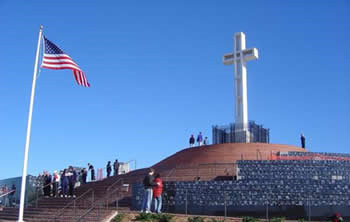
The Thomas More Law Center, which does such great pro bono public interest work, has prepared a letter asking the president to help preserve the Memorial Cross from efforts to destroy it by secular zealots.
I'm not exactly sure why a tiny group of chronic complainers feel so threatened by this cross and other symbols meant to honor our nation's heritage. But they won't stop until all traces of religious faith are erased from public sight. And then they'll find something else to destroy. They only reason they are succeeding is because they complain so loudly while we who disagree stay silent.
Posted by: annika at
10:49 AM
| Comments (36)
| Add Comment
Post contains 156 words, total size 1 kb.
May 25, 2006
One wonders why Bush would select Goss to a head an agency where the top guys already had an axe to grind against him. That couldn't have been the plan, since Hayden is now planning to re-hire a guy who quit because of Goss -- as Hayden's new deputy! What a mess.
Posted by: annika at
04:09 PM
| Comments (5)
| Add Comment
Post contains 165 words, total size 1 kb.
So which is it?
Posted by: annika at
02:16 PM
| Comments (15)
| Add Comment
Post contains 80 words, total size 1 kb.
May 16, 2006
Bush talk of immigrant amnesty divides GOPYou might think, reading that headline, that Bush is in favor of amnesty. Yet nowhere in the story do the writers provide this important quote from the text of the speech, which might provide some important explanatory context to their headline:
[W]e must face the reality that millions of illegal immigrants are already here. They should not be given an automatic path to citizenship. This is amnesty, and I oppose it. Amnesty would be unfair to those who are here lawfully and it would invite further waves of illegal immigration.Look, I know and you know that Bush's plan amounts to amnesty. But the press is supposed to be accurate and impartial. By crafting an inflammatory and misleading headline, and then "forgetting" to provide Bush's own disclaimer from the very speech that this story is supposed to be about, MSNBC is deliberately trying to pour gas on this GOP fire.
That's another reason why I never watch that channel.
Posted by: annika at
09:13 AM
| Comments (21)
| Add Comment
Post contains 203 words, total size 1 kb.
77 queries taking 0.2587 seconds, 381 records returned.
Powered by Minx 1.1.6c-pink.

